

Lunar New Year is the biggest holiday in Taiwan. It’s a time of vibrant celebration that lets visitors dive into Taiwanese culture. But how can you really feel like a local during this festive season? Let’s explore the traditions, tastes, and customs that make Lunar New Year in Taiwan so unique.
Key Takeaways
- Explore the unique Lunar New Year calendar and public holiday dates in Taiwan.
- Participate in traditional family gatherings and reunions.
- Savour the symbolism and significance of essential Taiwanese New Year foods.
- Uncover the rituals and etiquette behind temple visits and red envelope traditions.
- Discover the best ways to celebrate the Lunar New Year like a local in Taiwan.
Understanding Taiwan’s Lunar New Year Calendar and Dates
As you get ready to celebrate lunar new year in Taipei, knowing the Taiwanese new year customs is key. The Lunar New Year in Taiwan is based on the Chinese lunar calendar. This calendar follows the moon’s cycles, not the sun’s.
The holiday includes New Year’s Eve (chu xi), New Year’s Day (chu yi), and more days after. In 2025, the holiday will be from January 25 to February 2. This long period lets people enjoy many traditions, like family gatherings and temple visits.
“Lunar New Year is celebrated by billions of people worldwide on the first new moon of their calendar.”
Chinese New Year, or the Spring Festival, is from the first to the fifth day of the first month. It has ancient roots in China’s “Guo Nian” traditions.
- The Lunar New Year in Taiwan is like mainland China’s, thanks to the Han Chinese majority.
- Today, Taiwanese people might visit Buddhist or Taoist temples with family during the celebrations.
- Old customs from the Ming and Qing Dynasties are still kept alive in Taiwan during Lunar New Year.
Whether you live here or are just visiting, learning about Taiwan’s Lunar New Year is exciting. It’s a chance to dive into a rich and lively tradition.
Traditional Family Gatherings and Reunions
Celebrating the Taiwanese Lunar New Year means coming together with loved ones. It’s a time to honour cherished traditions. At the heart of these festivities are the family gatherings and reunions that take place throughout the holiday period.
On New Year’s Eve, families across Taiwan gather for a grand reunion dinner, known as the “Tuan Nian Fan.” Relatives from near and far come together at the paternal ancestral home or hometown. They enjoy a feast laden with symbolic dishes, such as fish for abundance and dumplings resembling ancient gold ingots for wealth.
- The New Year’s Day continues with more family activities and bonding.
- The second day, or “Chu Er,” is traditionally reserved for visiting and celebrating with maternal relatives.
These gatherings are a time to indulge in good food, play traditional games like mahjong. It’s also a time to observe the longstanding custom of elders giving red envelopes (hongbao) filled with money to the younger members of the family. Symbolising the passing down of fortune and good wishes.
“The Lunar New Year in Taiwan is truly a celebration of family, tradition, and the bonds that tie us together, even across generations.”
By immersing yourself in these Taiwanese new year customs, you’ll gain a deeper appreciation for the rich cultural heritage. You’ll also understand the importance of family in this vibrant festival.
Essential Taiwanese New Year Foods and Their Symbolism
Taiwanese Lunar New Year celebrations are filled with rich culinary traditions. Each dish has its own symbolic meaning. A few foods are especially important during these festivities.
Nian gao, a sticky rice cake, is a key dish. It symbolises growth and advancement in the new year. Its name, similar to “growing taller,” brings hopes for prosperity and positive change.
- Dumplings, known as jiaozi, are also essential. They are believed to bring wealth and good fortune. Their crescent shape looks like ancient Chinese gold ingots.
- A whole fish, often left with some uneaten, symbolises abundance. It represents the wish for a bountiful year. This tradition ensures continuous prosperity.
Pineapple is also significant during Lunar New Year in Taiwan. Its golden colour and the Mandarin word for “pineapple,” ananás, sound like “arrival of wealth.” It’s a favourite for decorations and gifts.
“The Taiwanese tradition of cleaning before New Year’s Day is related to the belief that sweeping or washing on New Year’s Day could remove good luck.”
Many Taiwanese restaurants offer special Lunar New Year menus. This lets locals and visitors enjoy the flavours and symbolism of this cherished tradition.
How to Celebrate Lunar New Year Like a Local in Taiwan
Dive into the lively Lunar New Year celebrations in Taiwan. Here, old traditions meet new ways. To celebrate like a local, follow these customs and modern practices:
- Join Family Gatherings and Reunions: Meet with your family for big meals, share wishes, and look back on good times.
- Try Traditional Taiwanese Foods: Enjoy dishes like niengao (sticky rice cakes), songgao, fagao, and luobogao. They bring luck and prosperity.
- Visit Temples and Honour the Lunar New Year: Go to local temples, light incense, and join in rituals. This connects you to the celebrations’ spiritual side.
- Exchange Red Envelopes (Ang Pao): Give ang pao to family and friends. It’s a sign of luck and wishes for the future.
Get into the spirit by joining the fun. Say Xin nian kuai le (Happy New Year) or Gong xi fa cai (Wishing You Prosperity) to locals. Enjoy firecrackers, mahjong, and the lively night markets. Experience the sights, sounds, and tastes of Taiwan’s Lunar New Year.
“The Lunar New Year in Taiwan is a time-honoured tradition that brings families and communities together, celebrating the rich cultural heritage and ushering in a new era of prosperity and harmony.”
By embracing Taiwanese Lunar New Year traditions, you’ll make unforgettable memories. You’ll also learn more about Taiwan’s vibrant culture.
Temple Visits and Religious Customs
Temple visits and religious customs are key to celebrating the Lunar New Year in Taiwan. At midnight on New Year’s Eve, many Taiwanese go to local temples. They pray and seek blessings for the year ahead. Longshan Temple in Taipei is especially popular, drawing many to experience the spiritual side of Taiwanese new year customs.
By observing these religious practices, visitors dive into lunar new year in Taipei‘s rich cultural heritage. They light incense, candles, and present offerings. These rituals show the deep beliefs and traditions of the Taiwanese people. Taking part in these customs offers a unique and deep look into the Lunar New Year’s spiritual side.
“The temple visits during the Lunar New Year are not just about making wishes for the future. They are a way for us to connect with our ancestors and our cultural identity.”
Whether you’re Taiwanese or just visiting, joining in these traditions is rewarding and memorable. The temples’ stunning architecture and the energy of the worshippers give a peek into Taiwanese culture and its lasting traditions.
- Observe the midnight rituals at Longshan Temple in Taipei
- Offer incense and prayers for prosperity in the new year
- Participate in traditional ceremonies and rituals at local temples
- Explore the intricate architecture and spiritual atmosphere of the temples
- Immerse yourself in the collective energy of the Lunar New Year celebrations
Embracing temple visits and religious customs is essential for fully experiencing Taiwanese new year customs. These practices honour the past and connect us to the present and future prosperity.
Red Envelope Traditions and Etiquette
During the Taiwanese lunar new year, exchanging red envelopes, or “hong bao,” is a cherished custom. These red packets filled with money symbolise good fortune and happiness. They also strengthen family bonds. As you learn to celebrate like a local in Taiwan, knowing the etiquette of these red envelopes will make your experience richer.
Married adults give red envelopes to children and unmarried people as a blessing. The money inside should be even, as odd numbers are linked to funerals. It’s polite to receive the envelope with both hands and not open it in front of the giver.
In Northern China and Taiwan, couples give one red envelope together. In Hong Kong and areas influenced by Cantonese, they give two. Employers also give red envelopes as bonuses, often worth a month’s pay.
“The Chinese New Year red envelope tradition, known as hóngbāo in Mandarin, is believed to have originated during the Qin Dynasty (221-206 BC).”
The number 8 is lucky because it means prosperity. But the number 4 is unlucky in Chinese culture.
Today, red envelopes are exchanged through mobile apps like WeChat. This shows how the tradition has adapted to the digital age. Yet, the red envelope’s symbolic value remains strong, showing love, respect, and the importance of family during the Taiwanese lunar new year.
Decorating Your Home the Taiwanese Way
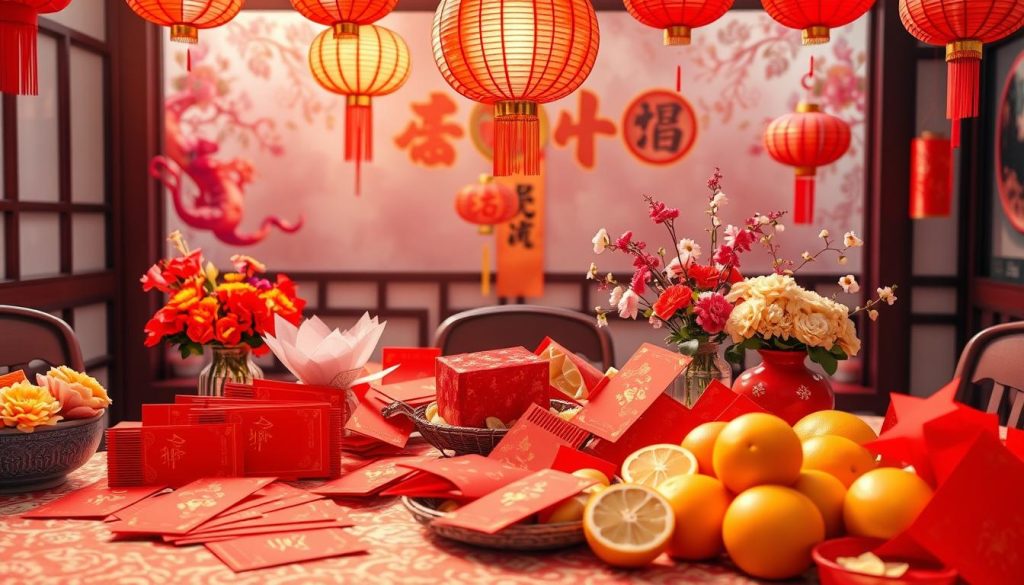
As the Lunar New Year festivities in Taiwan approach, homes across the island nation come alive with vibrant decorations. Taiwanese families put great effort into adorning their abodes with traditional elements. These elements symbolise good fortune and prosperity for the year ahead.
At the heart of Taiwanese new year decorations is the colour red. This auspicious hue dominates, from the glowing red lanterns hung outside to the spring couplets – auspicious phrases written on red paper – that grace entryways. The red represents joy, luck, and a warm welcome for the new lunar cycle.
- Red lanterns are commonly suspended from trees, office buildings, and house doors during the Lunar New Year celebrations.
- Spring couplets, often posted in pairs, convey wishes for a prosperous new year.
- Intricate paper cuttings, featuring auspicious plants and animals, adorn walls and windows.
Alongside the crimson accents, fresh flowers bring a sense of spring and renewal into Taiwanese homes. Plum blossoms and cherry blossoms are particularly popular, symbolising the start of a new beginning.
“Decorating the home for Lunar New Year is a deeply rooted tradition in Taiwan, creating a festive atmosphere and ushering in good fortune for the year ahead.”
Whether it’s the vibrant red lanterns, the delicate paper art, or the delicate blooms, Taiwanese new year decorations reflect the rich cultural heritage. They also show the hopeful spirit of the Lunar New Year festivities.
Popular Activities During the Holiday Period
As the lunar new year celebrations start in Taiwan, people enjoy many fun activities. The night market scene is a big hit. Here, you can try tasty foods, see dragon and lion dances, and soak in the festive vibe.
Many Taiwanese also love to explore the country’s beautiful spots. Places like Taipei 101, Chiang Kai-shek Memorial Hall, and Yangmingshan National Park are favourites. They offer a mix of culture and nature that’s perfect for this time of year.
For those who love adventure, hiking and visiting hot springs in Beitou are great. These spots let you get away from the city and enjoy nature’s calm. It’s a great way to balance the lively celebrations around the island.
“The lunar new year celebrations in Taiwan are a unique blend of ancient traditions and modern experiences, offering something for everyone to enjoy.”
Whether you’re at the night markets, visiting famous landmarks, or enjoying nature, the lunar new year in Taiwan is unforgettable. It’s a journey filled with culture and memories that will stay with you forever.

Navigating Transportation During the Festival Rush
Celebrating the lunar new year in Taipei like a local in Taiwan is rewarding but comes with challenges. One big challenge is dealing with the busy transport network during peak travel times.
As people head to their hometowns to be with family, roads get crowded, and train tickets sell out fast. Booking your transport early is wise. The busiest days in 2025 are expected to be January 24-27 and January 31-February 2.
If you’re visiting Taiwan during the how to celebrate lunar new year like a local time, stay in big cities like Taipei on peak days. This avoids the stress of crowded transport and lets you enjoy the festivities without long commutes.
For shorter trips, think about using local trains or buses. They’re often less crowded and reliable than high-speed rail or long-distance buses during holidays.
“Navigating transportation during the lunar new year in Taiwan can be a challenge, but with some advance planning, you can enjoy the festivities without the stress of being stuck in traffic.”
Remember, being patient and flexible is crucial when travelling in Taiwan during the lunar new year celebration. With some planning and flexibility, you can dive into the cultural traditions and make unforgettable memories in this magical island.
Special Events and Night Market Experiences
As the lunar new year festivities in Taiwan start, a world of special events and night markets awaits. The Taiwanese new year customs shine, giving visitors a deep dive into culture.
The Lantern Festival, marking the end of Lunar New Year, is a must-see. In 2025, it will be in Taoyuan from 12th to 23rd February. Expect stunning lanterns, laser shows, and festive shows. The Pingxi Sky Lantern Festival is another highlight, with hundreds of lanterns soaring into the sky on 8th and 12th February.
Visiting Taiwan without checking out the night markets is missing out. Taipei has many, like Shilin and Raohe Street Night Markets. These places are full of traditional street food, from stinky tofu to oyster omelets.
- Shilin Night Market: Known for its varied street food offerings, including stinky tofu, bubble tea, and giant fried chicken steaks.
- Raohe Street Night Market: Renowned for its traditional Taiwanese snacks like pepper buns, pork rib soup, and grilled squid.
- Ningxia Night Market: Popular among locals and famous for Tainan-style rice cake and oyster omelets.
- Ximending Night Market: Stands out for its fusion of youth culture and traditional street food, with Taiwanese-style fried chicken and bubble milk tea being popular choices.
- Tonghua (Linjiang Street) Night Market: Provides a more intimate setting, favored for dishes like Taiwanese sausages and pan-fried buns.
These night markets are not just for food. They also have clothes, electronics, handicrafts, and souvenirs. It’s a place for both food lovers and shoppers.
“Visiting Taipei’s night markets is like stepping into a vibrant time capsule, where the essence of Taiwanese culture and tradition comes alive in the most delightful way.”
Whether you’re at the grand Lantern Festival or the lively night markets, the lunar new year festivities in Taiwan are unforgettable. They celebrate the rich Taiwanese new year customs in a unique way.
Modern Changes in Taiwanese New Year Celebrations
The Taiwanese lunar new year traditions are changing, blending old and new. Family gatherings, red envelope exchanges, and special dishes are still key. But, the holiday now also includes modern trends and experiences.
In cities like Taipei, you’ll see more attractions and shops open during the new year. This offers new ways to enjoy the holiday, beyond family reunions. Some young people even travel abroad, showing a shift in what they value.
Despite these changes, the heart of the Taiwanese lunar new year remains strong. It’s a time to keep traditions alive and enjoy new activities. This mix of old and new shows Taiwan’s rich culture and forward-thinking spirit. It makes your visit to the Lunar New Year celebration unforgettable.